

Published: 6 December 2025
The Biden–Trump transition was always going to reshape transatlantic relations. But few expected the rupture to be so blunt, so deliberate, and so strategically disruptive.
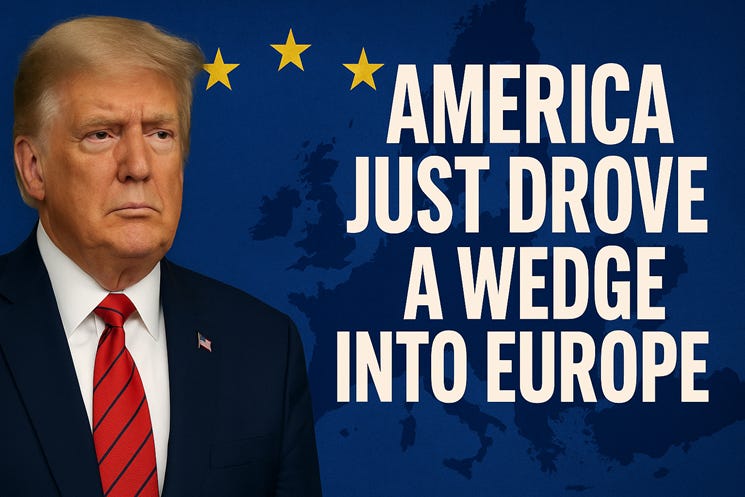
Yet that is exactly what happened when the Trump administration released its 2025 National Security Strategy — a document that claims Europe is on the brink of “civilizational collapse” due to migration, demographic change, and the influence of its own EU institutions.
This is no routine foreign-policy critique. It is an explosive intervention directly aligned with the talking points of Europe’s sovereigntist and populist governments. And it comes at the worst possible moment for a European Union already struggling with internal fractures, a stalled war in Ukraine, and a renewed push from the Commission for deeper federalisation.
The United States has now openly taken sides in Europe’s internal political war — and the consequences will be profound.
A Divided Europe Meets an Unfriendly U.S. Narrative
The claim that Europe is undergoing cultural “unravelling” is not new in Washington’s right-wing ecosystem. What is new is that it has been elevated into official U.S. strategic doctrine.
This lands directly in Europe’s most volatile political fault line: the battle between those who want deeper integration and those who want to claw powers back to national capitals.
The European Commission is pursuing a bold agenda — common migration screening, defence cooperation, industrial policy, and rule-of-law conditionality. In response, Viktor Orbán, Slovakia’s Robert Fico, and now potentially the incoming Czech government are building a sovereigntist firewall to resist anything resembling federalisation.
Trump’s NSS hands these governments the greatest gift imaginable: ideological validation from the world’s most powerful nation.
Orbán has spent a decade arguing that Brussels is blind to Europe’s “real” identity crisis. Washington has now endorsed his worldview almost verbatim.
Why the EU Cannot Respond as One
The EU’s strength has always come from unity. The NSS undermines precisely that.
A coordinated EU condemnation is unlikely for three reasons:
First, the sovereigntist governments won’t sign it.
Orbán will praise the document. Fico will reference it in domestic battles. Prague may follow. With unanimity required for major foreign-policy statements, the EU’s official voice is effectively vetoed.
Second, a number of “swing states” won’t want to pick a fight with the U.S.
Italy, Greece, Romania, Croatia, Bulgaria — all will see little political upside in confronting Washington, especially on a cultural issue that resonates with parts of their own electorates.
Third, the EU’s migration and identity divides cut across domestic party lines.
Even pro-European governments must manage electorates increasingly anxious about migration, integration, and demographic change. The NSS weaponises these debates, making consensus harder, not easier.
The result: the EU’s silence will not reflect agreement — it will reflect paralysis.
A Strategic Shift: Washington Has Chosen Its European Allies
For decades, the U.S. remained neutral in internal EU political debates. No longer.
The NSS effectively anoints a new set of preferred partners inside Europe — not Berlin, Paris or Brussels, but Budapest, Bratislava, and elements of the Czech and Austrian right.
This is a profound shift.
It means that the sovereigntists are no longer domestic challengers to the EU order; they are now backed by a global power.
It also means the European Commission’s long-running rule-of-law disputes with Hungary and Slovakia will be reframed by those governments as “political persecution encouraged by Brussels but opposed by Washington.”
The U.S. may not intend to undermine the EU.
But the practical effect is exactly that.
Europe’s New Reality: A Two-Speed Union Is Now Inevitable
If the NSS accelerates any trend, it is the quiet but steady evolution toward a two-tier Europe.
Core Europe — Germany, France, the Nordics, Benelux, Iberia — will push ahead with federalisation, strategic autonomy, defence coordination, industrial policy, and migration reform.
The sovereigntist bloc will increasingly position itself as a counter-model, retaining treaty membership but resisting all deeper integration.
Swing states will cherry-pick between the two pathways.
This is not federalisation by choice.
It is federalisation by survival.
Trump’s NSS confirms to Brussels that the U.S. can no longer be relied upon to uphold the post-war European order. If Europe wants to remain a geopolitical actor, it will have to consolidate internally — even if that means leaving some members behind.
Ukraine Will Become Another Casualty
The NSS arrives at a delicate moment in the war.
Some EU countries — Poland, the Baltics, the Nordics — remain fully committed to Ukraine’s defence and long-term security. Others want de-escalation and early settlement.
The U.S. intervention will not unify these positions. It will deepen them.
Orbán and Fico will point to the NSS as evidence that Brussels has mishandled Europe’s strategic direction. They will use it to obstruct EU funding for Ukraine, oppose sanctions, and portray themselves as the responsible guardians of national interest.
This is a gift to the Kremlin.
A divided Europe is far easier to manage than a united one.
China and Russia Are the Silent Beneficiaries
Europe’s difficulties rarely stay contained within Europe.
· Russia benefits because the EU’s sanctions, military support, and political unity become harder to maintain.
· China benefits because a divided EU cannot form a coherent policy on de-risking, technology dependence, or industrial competition.
For Beijing, Europe’s fragmentation is an open invitation for asymmetric influence and strategic investment — the exact dynamic the EU has been trying to contain.
The West Now Speaks With Two Voices
The deeper geopolitical consequence is the erosion of the transatlantic idea itself.
For the first time since 1945:
The U.S. and the EU pursue explicitly different visions for Europe’s political future.
The U.S. is siding with anti-federalist forces inside the EU.
The narrative of a “declining Europe” has become embedded in official U.S. doctrine.
What Washington calls a cultural warning, Brussels sees as a political attack.
And what the EU views as responsible integration, parts of Washington now frame as ideological decay.
This divergence is not tactical. It is structural.
Europe Must Now Decide Whether to Drift or to Act
The EU has two choices.
It can continue to drift into factionalism, allowing Washington’s domestic culture wars to become Europe’s external geopolitical pressure. Or it can recognise that the era of automatic transatlantic convergence is over — and start building its own strategic centre of gravity.
This requires:
a credible European defence capability
a realistic migration model
a reformed decision-making system
and a willingness to proceed with integration even without unanimous consent
Europe has spent decades debating these ideas.
Now they become necessities.
Washington has made its move.
Brussels must respond — not with words, but with architecture.
Leon Vermeulen is an independent historian and commentator specialising in European memory, conflict, and reconciliation.
Hum…
Europe political union was a great idea and could have been a truly historical project.
But the European transnational elite and the Eurocrats that were installed at its head to run the show betrayed it a long time ago.
The milestone in France is 2005 when French people democratically rejected the European Union treaty by referendum. Only to have it forced on them a few month later by politicians who decided they knew better.
In the meantime, the EU leaders made everything they can to undermine national sovereignty wherever it was possible. Elected parliaments were turned in mere registration chambers for anything decided in Brussels. Millions of foreigners were let into Europe to weaken national cohesion while, of course, whoever objected was labelled "racist", "far right" and so on. They mingled with every elections, threatening to cancel the result (and actually doing it !) if people dared to vote the "wrong" way. They signed all kind of free trade agreements, even at the cost of European agriculture and thus our most basic sovereignty. And so on, and so forth for decades now.
Only the English people managed to get out. But their exit was made as difficult and ineffective as possible to show all the other European people how costly and useless it would be if they had the same idea.
Then came 2014 and the Maidan coup in Kiev. And instead of fulfilling political Europe's historical goal and main raison d'être which was to promote peace on the continent, they decided to follow blindly the US neocon and Democrats administration's adventure, making everything they can to be sure that Russia will be involved in the worst possible way. Even at the cost to accept that Europe was cut off from its main energy supplier.
The idea is simple : by manufacturing a threat on the East, they hope to force federalism on European people who already had more than enough. That's the only way they can still hope to stay in power. And if war end up breaking out, they hope to force whoever occupies the Oval Office to come to their aid.
But Trump and Vance are not crazy. They see it coming. They don't want to be dragged in that mess. And they're not choirboys either. They will play their own cards too.
Now there are only 2 questions left :
Will European people wake up and be able to make their voice heard ? Nothing is less certain, because the whole political system is very well locked down.
What will be left of the European project and civilisation after that ? Sadly, probably not much...
EU - RIP